
Anoka County City Directory Holdings
An old printed line can answer what a database cannot. The Anoka County city directory volumes captured who lived where on a fixed date. That makes them gold for tracing a family, a business, or a house. A residents directory search starts with a surname, a business name, or a street address. From there you can find who lives on a street in Anoka County. You can also see who lived there decades ago. The surviving run is patchy, though. Gaps are common, so treat each listing as one clue. Lean on telephone books, microfilm, and maps to fill the spaces. Care beats speed here.
| Collection | Years | Where held | Access |
|---|---|---|---|
| Anoka printed directory | 1889–90 | Anoka County Historical Society research holdings | Ask ACHS about the cited volume and local research access |
| Anoka printed directory | 1915 | Anoka County Historical Society research holdings | Archive inquiry or visit |
| Anoka telephone directories | 1920–1950 | ACHS local-history material | White-page and business-page research |
| Anoka telephone books | 1953 and 1957 | ACHS Farmers Hotel research examples | Archive inquiry or visit |
| MNHS telephone-directory finding aid | City and year vary | Minnesota Historical Society | Check city, year, and shelf number before ordering |
| MNHS online directory collections | St. Paul 1856–1922; Hennepin County 1859–1983 | Minnesota Historical Society digital collections | Online regional context, not an Anoka substitute |
ACHS points to gaps across the late 1910s and early 1920s. Its telephone-book trail shows a 1951/52 hole as well. A hit is valuable because the volume carries its own date. A missing year matters just as much. It tells you when to pivot to microfilm, maps, or another repository. That way you stop assuming the record simply continues.
Anoka County Directory Chronology
Formats shift over the decades. Before modern street addresses became standard, an entry might identify a person by township, settlement, river, or post office. Anoka County formed in 1857. Anoka became the county seat that same year. Those older place descriptions can explain why a later directory seems to pick up mid-story, dropping a family or property trail without warning. The confirmed directory and map dates work best as checkpoints rather than a promise of unbroken annual coverage.
- 1885: a ten-sheet Anoka Sanborn set is identified in the Minnesota Historical Society index.
- 1888: ACHS identifies an ownership plat example that can connect a lot to its earlier geography.
- 1889–90: the first verified Anoka printed directory snapshot in the local research.
- 1911 and 1915: the Library of Congress has a 15-sheet Anoka Sanborn map for March 1911, and a 1915 directory volume is verified.
- 1920–1957: the documented telephone-book trail includes a 1920–1950 run and examples from 1953 and 1957.
Ownership plats from 1914 and 1932 add a second kind of date marker. A plat fixes lot lines and ownership geography. A printed directory or telephone book supplies the household or business clue. The two roles are different. Keeping them separate keeps a title record from being mistaken for a list of occupants. That slip can send research down the wrong path. Note: Record the directory year and the later record date separately whenever a catalog, scan, or finding aid delivers an older volume.
Reading Anoka County City Directory Entries
A printed Anoka County directory entry is an index line, not a biography. Expect a name, a street address, an occupation or business label, and telephone details where the source is a telephone book. The listings nearby fill out the picture. The volume decides what appears. Children rarely show up. Spouses and other household members often go unprinted unless they held their own listing. Entries can lag a move by a year or more. So pair the line with another dated source before building a residence chronology from it.
| Name as printed | Preserve initials, spelling, suffixes, and any business or organization label exactly. |
|---|---|
| Street or address | Record the address, then compare it with the directory year and a map or parcel source. |
| Occupation or business label | Treat it as the volume’s description of the entry, not a complete account of the household. |
| Telephone or business page | Telephone books may distinguish alphabetical white pages from business yellow pages. |
| Adjacent listing | Nearby entries can suggest a street sequence, but they still need address and year confirmation. |
- Criss-cross directory
- An address- or street-order directory section used to begin with a location instead of a surname. No official Anoka run or dates were verified in the research.
- Householder index
- A name-order part of a volume that points to household listings when the publisher included one.
- Abbreviation key
- The volume’s explanation of shortened words and marks. Photograph or transcribe it before interpreting an unfamiliar entry.
A careful note earns its keep. Log the title, city, year, publisher if shown, page, the name exactly as printed, the address, any telephone or organization field, neighboring entries, and the image or shelf reference. That worksheet lets you return to the same line later without a spelling or street form quietly changing along the way.
Anoka County Archive Search Routes
The Anoka County Historical Society research resources page catalogs the local archive's newspapers, directories, maps, cemetery material, census leads, photographs, and manuscript collections. ACHS sits at 2135 3rd Avenue North in Anoka. Its phone is 763-421-0600. The research FAQ asks family researchers to arrive with a full name, life dates, and relatives. For an address question, a name plus exact dates makes any request far more productive. The archive offers microfilm training. Some online collections remain a work in progress. Certain material is restricted, so ask ahead. This overview of the society's local collections draws on its research-resources page.
Directory work gets stronger when ACHS microfilm, maps, and newspaper notices sit beside the printed volume. They work as partners rather than substitutes. One service change is worth flagging. County library reference services at the Anoka County History Center are scheduled to end August 28, 2026. That shift does not touch ACHS archive access itself. So confirm hours and the collection you need before visiting. For remote requests, ACHS offers roughly 15 minutes of initial research at no charge. After that, the rate is $20 per hour plus photocopies and postage where they apply. One firm rule stands out. Provide an exact death date, because ACHS will not search obituary microfilm without one.
Anoka County City Directory Gaps
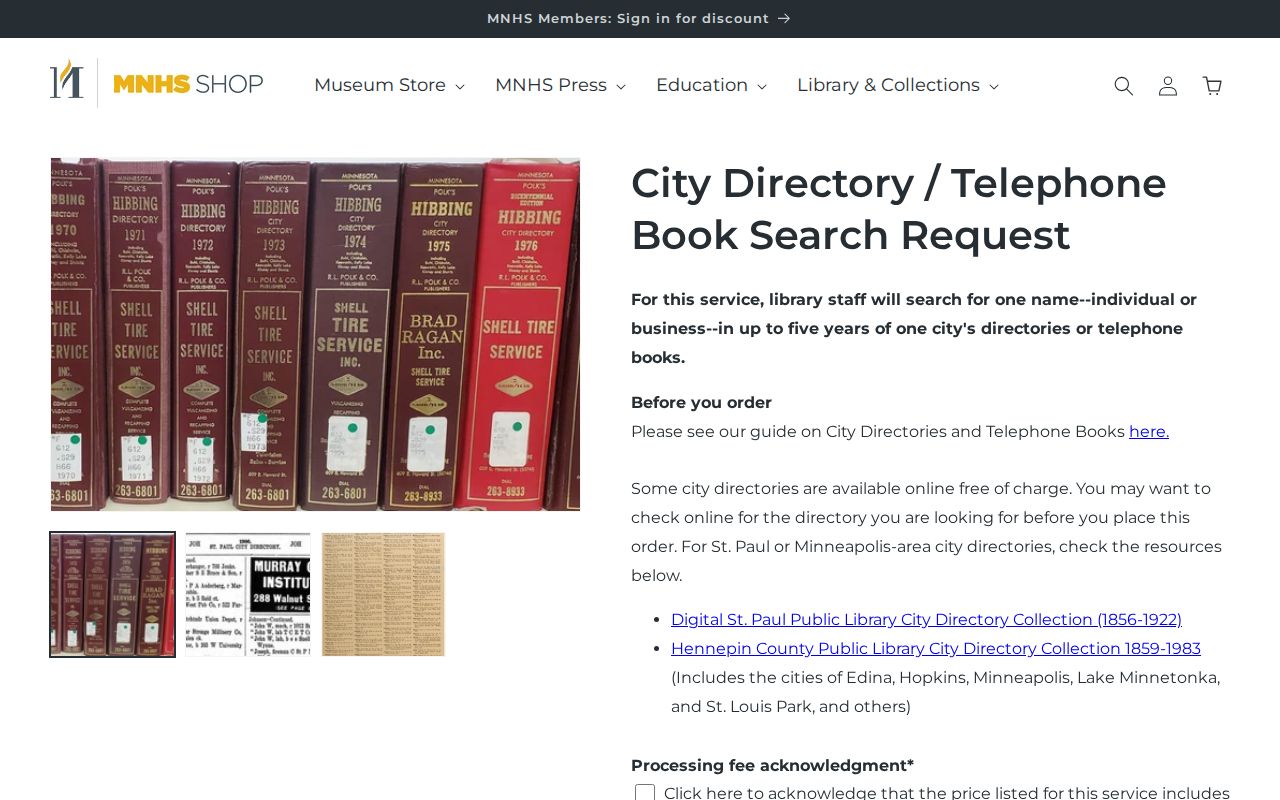
The Minnesota Historical Society runs a paid directory search request for Anoka researchers. One request covers a single name or business. It can span up to five years of one city's directory or telephone-book holdings. The service costs $20 plus a $5 nonrefundable processing fee. Timing usually runs three to four weeks. In slow cases it can stretch to 12 weeks. Digital delivery or scanning is available. But you must first confirm that MNHS actually holds the Anoka city and year you need. The online Digital St. Paul and Hennepin County collections it names are no proof that an Anoka volume is online.
A missing digital result is often a holdings question. It is not proof the person or business was never recorded. That point comes straight from the MNHS request screen. The practical route is to search the Anoka County telephone-directory finding aid by city and year. Jot down the shelf number, and then choose between a staff search, an archive visit, or an ACHS request. For confirmed holdings, the MNHS directory search-request service spells out the limits of a staff search. It also covers the timing.
Put the request route to work on a name or business with confirmed holdings. Save whatever comes back. Keep the city, year, and source image attached to your note. That way the Anoka County city directory trail stays testable.
Note: Do not infer a publisher or a full annual run. Also skip reverse-directory titles. Only rely on what the catalog or the volume itself states.
Anoka County Maps and Newspapers
Maps and newspapers explain why an address shifts shape over the decades in an Anoka County city directory. The Anoka County Historical Society lists ownership plats for 1888, 1914, and 1932. The Library of Congress digitized the March 1911 Anoka Sanborn map. It runs to 15 sheets. The MNHS index also spots a May 1885 Anoka set of ten sheets. A Sanborn sheet gives you building form, street, lot, materials, and use. It will not name residents. Match the sheet to a directory address. Then test that address against a parcel record, a deed, or an assessment roll.
Newspapers fill the gaps. ACHS microfilm holds the Anoka County Union from 1865 to 2002. It also holds the Anoka Herald from 1885 to 1960, plus selected issues of other local papers. When a street name fails, try Anoka, Rum River, Christian Hill, or Swede Town as period labels. Treat those labels as historical search vocabulary rather than legal boundaries. The 1884 fire destroyed 86 buildings. So a vanished 1880s address may take newspapers, plats, and later street directory volumes to sort out rebuilding or a new use.
Note: Treat any street or building match as geographic context. A dated directory, parcel, or archival record must corroborate it.
Trace an Anoka County Household
Work the printed Anoka County directory sequence one year at a time. Start with a volume holding a surname, business, or address you already trust. Copy the printed entry exactly. Modernizing spellings quietly erases evidence. Compare the next verified directory or telephone book. Do not assume every intervening year was published. The Farmers Hotel case shows why. A directory entry, probate and census context, telephone books, a tax record, and later volumes form a dated trail, and the archive gaps stay visible.
- Find the first verified Anoka County printed-directory or telephone-book entry and save the exact page or image reference.
- Follow the name and address through the next available local year, noting spelling, street, business, and telephone changes.
- Check a confirmed street-order or address section if the volume has one, but do not assume an unverified criss-cross run exists.
- Pair the directory years with ACHS census material, newspapers, a cemetery or obituary clue, and the relevant ownership plat or Sanborn sheet.
- For title questions, use the county property and recorded-document routes separately, because an owner, grantee, and directory household can differ.
A name that drops out of an Anoka County historical volume carries several possible meanings. It could signal a move, a death, a changed listing practice, a missed volume, or a collection gap. The absence alone proves nothing. When a historical directory line needs an official counterpart, the Anoka County resident lookup carries the current-record side of that verification.
Anoka County Directory Source Notes
Build a source card for every Anoka County historical-directory result. Record the repository, volume title, city, publication year, page or shelf number, printed spelling, address, and retrieval date. Then tag each companion item with its role. A directory or telephone book is a household or business lead. An ownership plat supplies property geography. A deed marks a recorded title event. A newspaper or obituary adds a dated notice. Keep those roles distinct rather than fusing them into one unsupported claim about a past resident.
Keep both the old place words and the modern map reference in older research. Rum River, township labels, and postal cities can all surface in a valid Anoka County trail. Formal municipal names belong there too. A source card preserves the difference. That habit makes later verification of any residents directory finding possible.